Note · Research
Why Dubai Derma Is Becoming a Key Gateway for Korean Aesthetic Medicine Brands
Why Dubai Derma Is Becoming a Key Gateway for Korean Aesthetic Medicine Brands
Dubai Derma has become one of the most closely watched dermatology and aesthetic medicine events for Korean companies looking toward the Middle East.
The event is not simply a beauty trade show. It brings together dermatologists, aesthetic physicians, clinic operators, distributors, medical device companies, dermocosmetic brands, and regional buyers across the Middle East, GCC, North Africa, and South Asia.
For Korean aesthetic medicine brands, that combination matters. South Korea has built strong global visibility in energy-based devices, injectables, dermocosmetics, clinical skincare, and minimally invasive aesthetic treatments. Dubai Derma places many of those categories in front of buyers who are actively looking for clinical, commercial, and distribution-ready products.
The 2026 edition of Dubai Derma is now scheduled to take place from September 8 to 10, 2026, at the Dubai World Trade Centre, after earlier schedule changes. For companies reviewing future participation, especially for 2027, the event’s popularity raises an important question: how should Korean brands prepare before they try to secure a booth?
Dubai Derma Is More Than a Beauty Exhibition
Dubai Derma is formally positioned around dermatology, skincare, and lasers. Its structure is closer to a professional medical and aesthetic business event than to a consumer beauty fair.
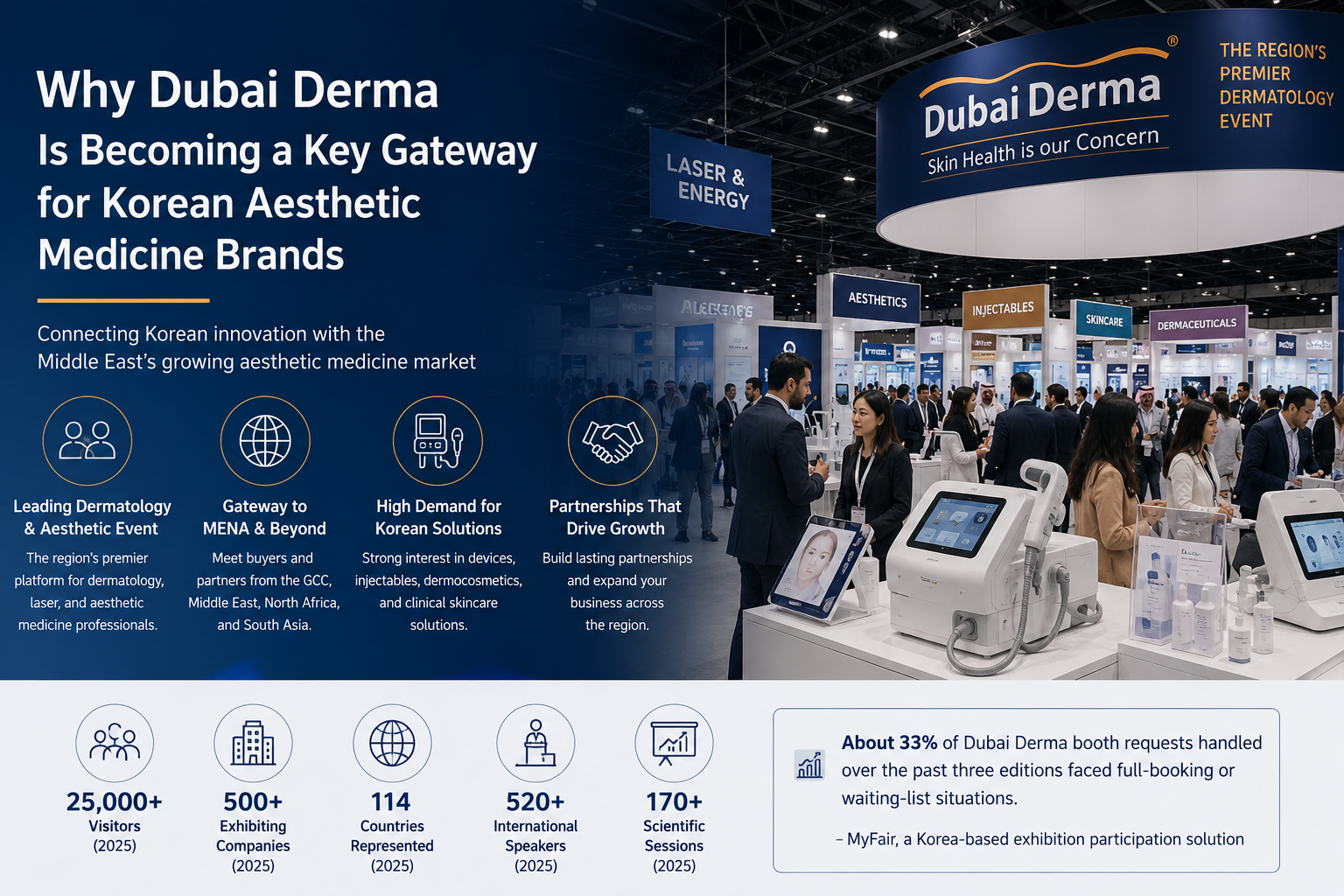
The exhibition runs alongside a dermatology and laser conference, which gives the event a strong clinical and educational character. According to the 2025 post-show materials, Dubai Derma featured more than 520 international speakers, 170 scientific sessions, over 500 lectures, and 18 CME-accredited hours.
This matters for exhibitors. Visitors are not only looking for attractive product displays. Many are evaluating whether a product can be used in clinics, distributed across the region, registered in local markets, and supported after sale.
That is why Dubai Derma is especially relevant for companies in categories such as:
energy-based aesthetic devices
dermatology lasers
injectables and fillers
botulinum toxin products
dermocosmetics and derma-pharmaceuticals
post-procedure skincare
hair and scalp treatment products
clinic equipment and consumables
professional aesthetic distribution products
For Korean companies, the event is a chance to present products not only as “K-beauty” items, but as clinical and commercial solutions for dermatology and aesthetic practices.
Why Dubai Matters for Aesthetic Medicine Companies
Dubai is not only a UAE market entry point. It is also a regional business hub connecting buyers from the GCC, the wider Middle East, North Africa, and South Asia.
That regional role makes Dubai Derma strategically important. A distributor meeting at the event may not be limited to the UAE. It can lead to discussions around Saudi Arabia, Kuwait, Qatar, Oman, Bahrain, Egypt, North Africa, or South Asian markets.
The medical tourism background also supports the event’s relevance. Dubai Health Authority reported that dermatology accounted for 31% of Dubai’s medical tourists in 2022, making it the largest specialty among medical tourism visitors that year.
For aesthetic medicine companies, this points to a broader pattern: dermatology, cosmetic procedures, clinical skincare, and medical wellness are becoming part of Dubai’s healthcare and tourism positioning.
As a result, Dubai Derma gives Korean brands access to buyers who are not only interested in retail beauty trends, but also in clinic-based treatments, professional distribution, patient demand, and repeat-use products.
Korean Participation Reflects the Fit Between Product Categories and Market Demand
Korean participation at Dubai Derma has been active, especially in medical aesthetics and dermocosmetic categories.
In 2025, Korea formed the largest national pavilion at Dubai Derma. Korean companies such as Huons affiliates, Jeisys Medical, and Jetema have also appeared in recent editions, reflecting the country’s strong presence in injectables, devices, fillers, and aesthetic medicine products.
Huons Group, for example, participated in Dubai Derma 2025 with group companies including Humedix, Huons Meditech, and Huons Biopharma. The group highlighted products such as HA fillers, Dermashine Pro, and Hutox as part of its effort to expand in the Middle East.
This shows why Dubai Derma is increasingly relevant for Korean exporters. Many Korean companies already have product portfolios that match the event’s core demand:
device-based aesthetic treatment
injectable solutions
clinic-oriented skincare
dermal fillers
botulinum toxin products
dermatology-related consumables
professional-use aesthetic products
However, strong Korean participation also means stronger comparison on the show floor. Buyers may see several Korean brands within similar categories during the same event. That makes product differentiation, regulatory readiness, pricing structure, after-sales support, and distributor terms more important than brand origin alone.
High Demand Also Makes Booth Access Competitive
For Korean companies, the challenge is not only whether Dubai Derma is relevant. The practical question is how early they can secure access to the show floor.
Popular exhibitions often become competitive before the official application deadline. Preferred booth locations, pavilion sections, and suitable booth sizes may be limited, especially when repeat exhibitors and national pavilion demand are strong.
Because of this, Korean aesthetic medicine companies often consider more structured participation routes rather than handling the entire process on their own. These may include Korean national pavilions, local sales agents, or external exhibition participation services that help manage booth applications and organizer communication.
One such example is MyFair, a Korea-based booth participation solution for overseas trade shows. According to MyFair, among Dubai Derma booth requests it handled over the past three editions, about 33% faced full-booking or waiting-list situations and did not immediately lead to confirmed participation in that edition. The company also noted that, for the 2026 edition, at least one booth request submitted roughly nine months before the show was still placed on a waiting list.
This suggests that Dubai Derma requires earlier planning than many companies may expect. For future editions, including 2027, Korean exhibitors may need to review booth availability and participation routes before waiting for the final stages of the application period.
Booth Participation Is Only One Part of Market Preparation
Securing a booth is important, but it is only the first step.
For Korean aesthetic medicine companies, Dubai Derma should be approached as a market-entry and partner-development event. That means exhibitors need to prepare not only a display booth, but also the materials and commercial answers that buyers are likely to request.
Before participating, companies should be ready to explain:
whether the product is classified as a cosmetic, medical device, pharmaceutical product, injectable, or clinical consumable
what certifications or regulatory documents are available
whether the product can be registered or distributed in the UAE or target GCC markets
what role a local partner would play in registration
how pricing, MOQ, and supply terms are structured
whether exclusive distribution rights are possible by country or region
how training, installation, consumables, and after-sales service are handled
what clinical or procedural materials can support buyer evaluation
For a laser or energy-based device company, buyers may ask about installation, technical training, maintenance, consumables, and clinical use cases. For a filler or injectable company, questions may focus on regulatory documents, practitioner education, cold-chain or storage requirements, and distributor responsibility. For dermocosmetic brands, buyers may look at ingredient claims, post-procedure use cases, registration status, pricing, and channel strategy.
In other words, Dubai Derma preparation is not only about being present at the event. It is about being ready for the next business conversation.
What Korean Brands Should Prepare Before Dubai Derma
Korean companies considering Dubai Derma should start by defining the purpose of participation.
Some companies may attend to find a first distributor in the Middle East. Others may want to meet existing partners, test product-market fit, launch a new product line, or compare regional competitors.
Those goals affect how the booth should be planned and what the company should prepare.
A Korean company entering Dubai Derma for the first time may need to focus on:
identifying target countries and buyer types
preparing English product materials
organizing regulatory and certification documents
deciding whether to join a national pavilion or apply independently
estimating booth size and staffing needs
preparing distributor questions and negotiation terms
planning pre-show meeting outreach
building a follow-up process after the event
A returning exhibitor may need a different strategy. Instead of simply repeating booth participation, it may focus on deeper distributor meetings, product demonstrations, clinical education, regional partner expansion, or new product launches.
This is why Dubai Derma is often more valuable when companies treat it as part of a longer market development plan rather than a one-time exhibition.
A Gateway, but Not an Automatic Shortcut
Dubai Derma offers Korean aesthetic medicine companies a valuable gateway into the Middle East and nearby regions. Its professional audience, medical focus, and strong regional buyer network make it one of the most relevant exhibitions for Korean companies in devices, injectables, dermocosmetics, and dermatology-related products.
However, the event’s popularity also creates competition. Korean brands are not entering an empty market. They are entering a show where buyers can compare multiple products, suppliers, and country pavilions in a short period of time.
For that reason, the most prepared companies will not only secure booth space early. They will also prepare regulatory documents, clinical evidence, distributor terms, training plans, and follow-up processes before the event begins.
Dubai Derma may open the door to the Middle East aesthetic medicine market, but the companies that benefit most will be those that arrive with a clear market-entry strategy, not just a booth.